“Granny Flats” Could Remake the Housing Market. Why Are They So Contentious?
Advocates say that accessory dwelling units, mother-in-law suites, cat mansions, or—as one couple built—sex dungeons can add affordable housing stock without changing the streetscape.
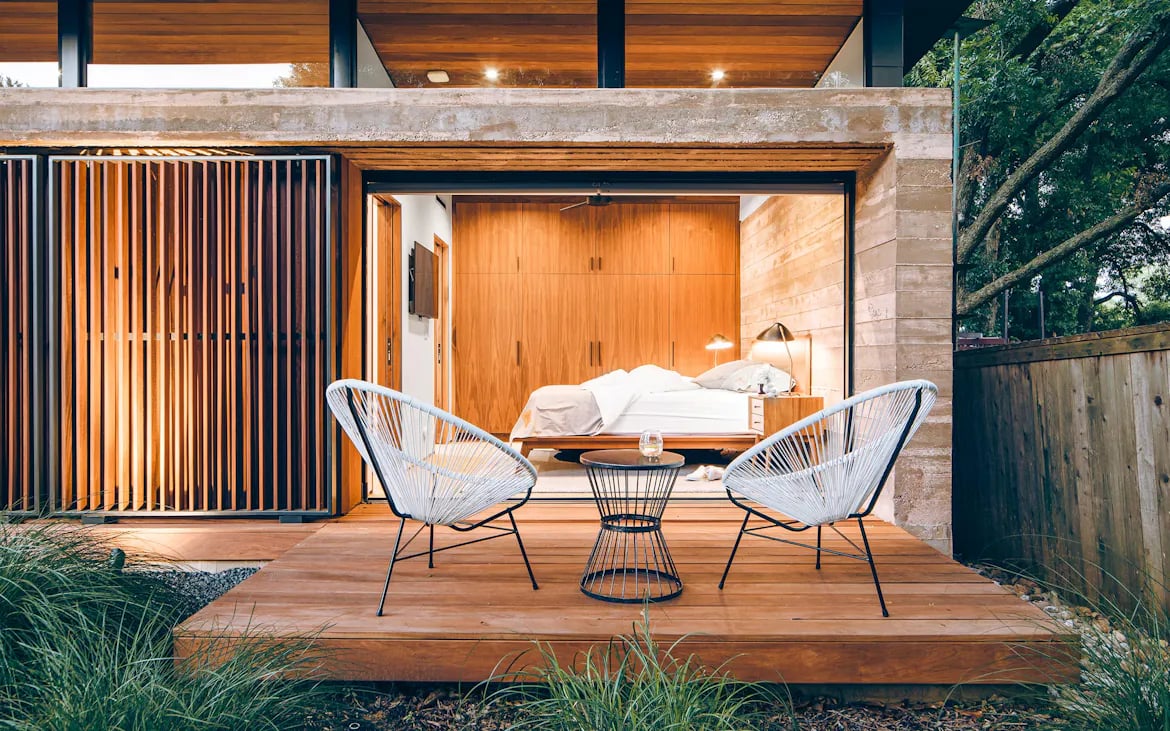
The Five House by M Gooden Design.Parrish Ruiz de Velasco/M Gooden Design
Painter Rachel Hecker purchased her 1920 bungalow in the Heights, northwest of downtown Houston, in 1987. It was charming and cheap—just $60,000—but uninsulated and teeny, with 1,100 square feet of space. She made do for years. Then, in 2019, she started researching options to expand. Adding on would cost $450,000, an astronomical sum more than seven times what she originally paid for the house. But a garage apartment? At roughly $200,000, it sounded a lot more doable.
She gave her contractor a paper maquette of precisely what she wanted: a modernist structure with a pitched roof, clerestory windows, and gray siding, which would sit beside and “shake hands with” her existing studio, like a miniature backyard campus. It doesn’t seem like something that would fit with the traditional architecture of the main house, yet, in a yin-yang way, it works. “I’m just happier when stuff isn’t matchy-matchy,” she says.
When she retires, Hecker might rent the place out for supplementary income. But for now, it serves as a dander-free guest suite for out-of-town friends who are allergic to her cat. When no one’s visiting, she escapes there to enjoy the “beautifully” efficient air-conditioning and “forceful” showerhead—and to watch period dramas on the 65-inch OLED flat-screen.
Hecker’s garage apartment is one of more than 150 accessory dwelling units—better known as ADUs—that her contractor, Mike Shelton, has built in Houston since 1998. The Heights neighborhood is famed for its leafy streets lined with single-family homes, some dating to the 1800s. But turn down an alley and a second world emerges, one with ancillary backyard structures soaring as high as three stories. Lately, Shelton has never been busier. “I call it the swimming pool syndrome,” he says. “Like, ‘My neighbor got a swimming pool, and now I want one.’ ”